










Now Available: Blank Foundation’s 2025 Annual Report
The Arthur M. Blank Family Foundation’s 2025 Annual Report is here, highlighting a year of...
What’s Good for the Gosling Is Good for the Gander
Last February, Ayumi (pronounced eye-YOU-mee) Abraham discovered that Mercedez-Benz Stadium was hosting a girls flag football clinic featuring current and past Atlanta Falcons players and coaches. The 5’10” junior was already a star point guard for North Atlanta High School, but she decided to give flag football a try.
In retrospect, it’s funny that she, rather than her dad, was the one who first heard about the clinic. That’s because her dad is John Abraham, a legendary Falcons pass rusher who rented space in the heads of NFL quarterbacks for 15 years.
A few months after the clinic, Ayumi told us that she loved participating—especially the opportunity to learn nuances of the game from top coaches. She enjoyed it so much that she then signed up for North Atlanta’s flag team and became a starting two-way player. “I get things from flag that I don’t get from basketball,” she said. “I meet more people, and I make more friends, including people from other high schools and cities. Flag football is good for me, physically and socially.”
It might be even better for her dad. “I’ve struggled with my mental health for years and had suicidal thoughts,” he shared with confident candor. “Helping Ayumi practice and watching her compete gives me such highs. I’ve read that flag football is good for girls’ mental health. Let me tell you, it’s also good for mine. Supporting her has been a support for me.”
Planting the Flag in Georgia
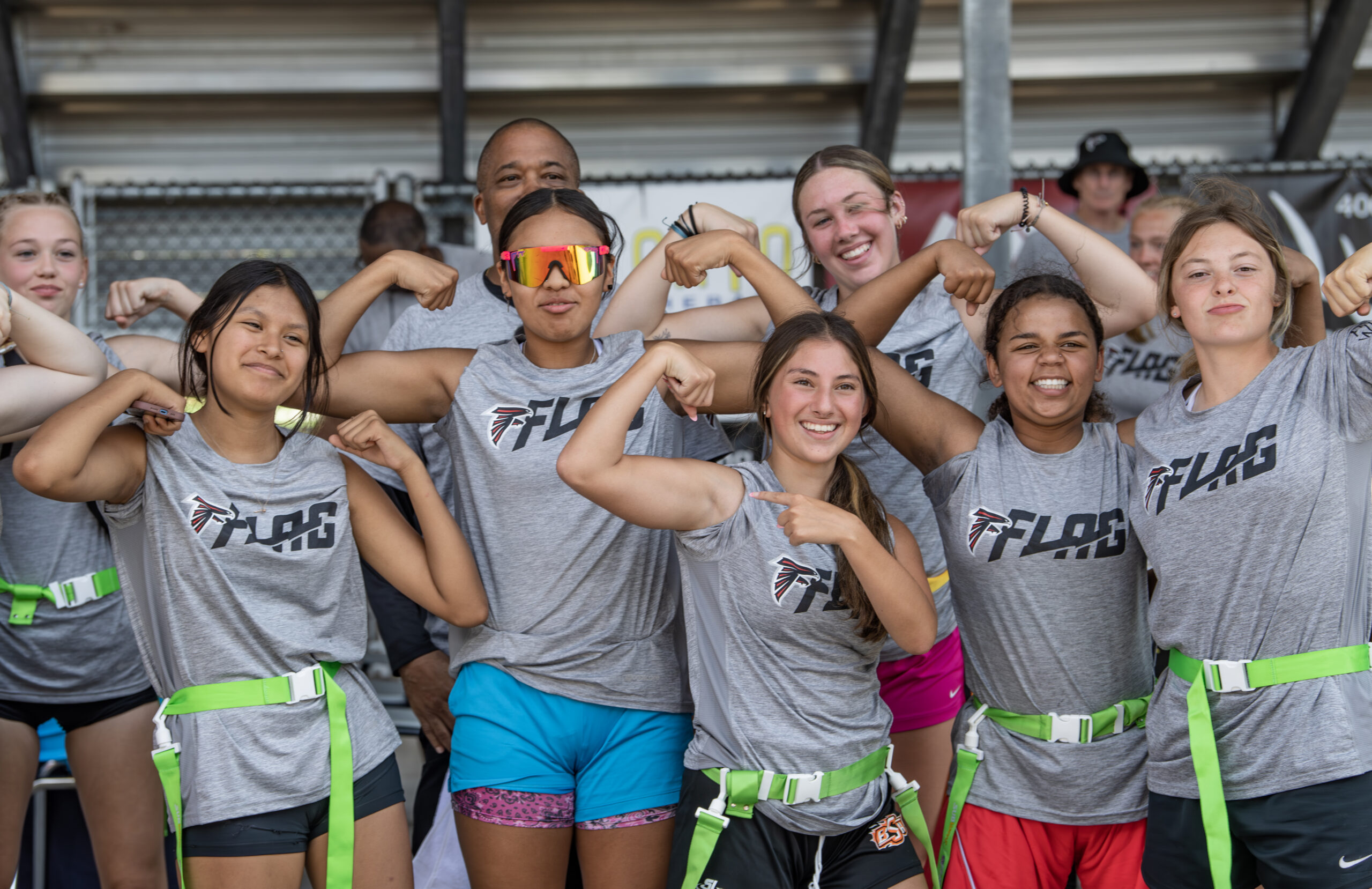
Like Ayumi and John, girls and their families have been embracing girls flag football all over the country. Nearly 500,000 girls ages 6-17 are now playing on organized teams, and more than 70,000 are playing for official high school teams.
The sport’s trajectory is stunning and unprecedented. The number of competitors has more than tripled over the past three years. Partly as a result of the interest among girls and boys alike, the International Olympic Committee approved women’s and men’s flag football as a sport in 2023, and it will premiere in LA in 2028.
Amanda Dinkel, the Atlanta Falcons Senior Director for Community Relations, has been one of the driving forces behind the growth of girls flag. In 2017, she was flying back from a sports conference in Florida when her plane hit a pocket of serious turbulence. “I don’t love flying around in a metal tube even when it’s calm,” she shared with a laugh. “So when we hit rough air, I dove into my notes from the conference to distract me. I saw that Florida has girls flag football, and my colleague Chris Millman and I started thinking about how our organization could support girls flag in Georgia.”
Within a month, Dinkel drove to Thomaston, Georgia, to meet with the leaders of the Georgia High School Athletic Association. Based on that conversation, the Falcons’ Community Relations team developed a plan for leveraging the human and financial resources of the Falcons and the Arthur M. Blank Family Foundation to help girls flag football become an official high school sport throughout Georgia. “I heard that the benefits for girls are amazing,” she said. “It provides gender equity and builds girls’ leadership skills. It’s a great way for girls of all body types, skills, and abilities to feel good about themselves. And 50 percent of the girls who decide to play flag have never played a sport before.”
The plan resonated throughout the Blank Family of Businesses, including with Arthur Blank himself. “Girls flag football reflects the passion, resilience, and determination of the young women driving this game forward,” Blank said. “Its remarkable growth shows just how strongly players and communities believe in its future. We remain deeply committed to expanding access, creating opportunities and helping the game thrive for generations to come.”
In 2018, the Falcons and the Arthur M. Blank Family Foundation provided 19 Georgia high schools with grants and professional guidance to help them create teams. Dinkel worried, privately, that the sport was so new that not enough girls would show up to play. In retrospect, she had no need to worry. “It turns out that girls love the sport, and we’ve never had an issue with demand. Even rural high schools with only 30 or 40 kids are making it happen,” she said.
Thanks to the success of the pilot, Georgia sanctioned flag football as an official high school sport two years later, making it the fourth state to do so. Today, every high school in the state is eligible to receive a grant from the Blank Foundation to support its existing team or launch a new program. That has allowed more than 300 high schools to do so—up from just the original 19 pilot schools eight years ago.
Back into the Metal Tube
The success in Georgia led the Falcons and Blank Foundation to replicate their work in Alabama and Montana. The uptake has been almost as rapid as it was in Georgia.
The Falcons playbook for advancing girls flag at the state level is very different from the complicated flag football playbooks that most high schools use. The advocacy playbook is based on four simple fundamentals:
Flag Football Is Real Football
Despite all this national momentum, Ayumi and John Abraham still hear skeptics question whether flag is real football. “Yeah, I hear that a lot,” Ayumi shared. “But let me tell you—it’s a real sport. It’s intense. Even if you’re good at tackle football, you might not be at all good at flag.” Ayumi has ample evidence on her side. This past March, some of the biggest NFL stars took on the country’s top men’s flag players. The NFL superstars got their comeuppance, losing all three games they played by significant margins.
John admitted that he, too, was once a flag skeptic. “I thought the same thing until I really got to know the game through Ayumi,” he said. “It is real football, just without the collisions. In fact, I would say it’s even mentally tougher than tackle, because everyone can contribute on every play, and anyone at any time can touch the ball. Everyone has to know multiple positions—on top of being super athletic.”
John and Ayumi hope you’ll come out to watch a game for yourself.
If you are experiencing suicidal thoughts, you can find immediate support by dialing 988.




Stay up to date with stories of impact, grants in your neighborhood and other interesting foundation news.